What a Military Intelligence Expert Learned in 30,000 Hours
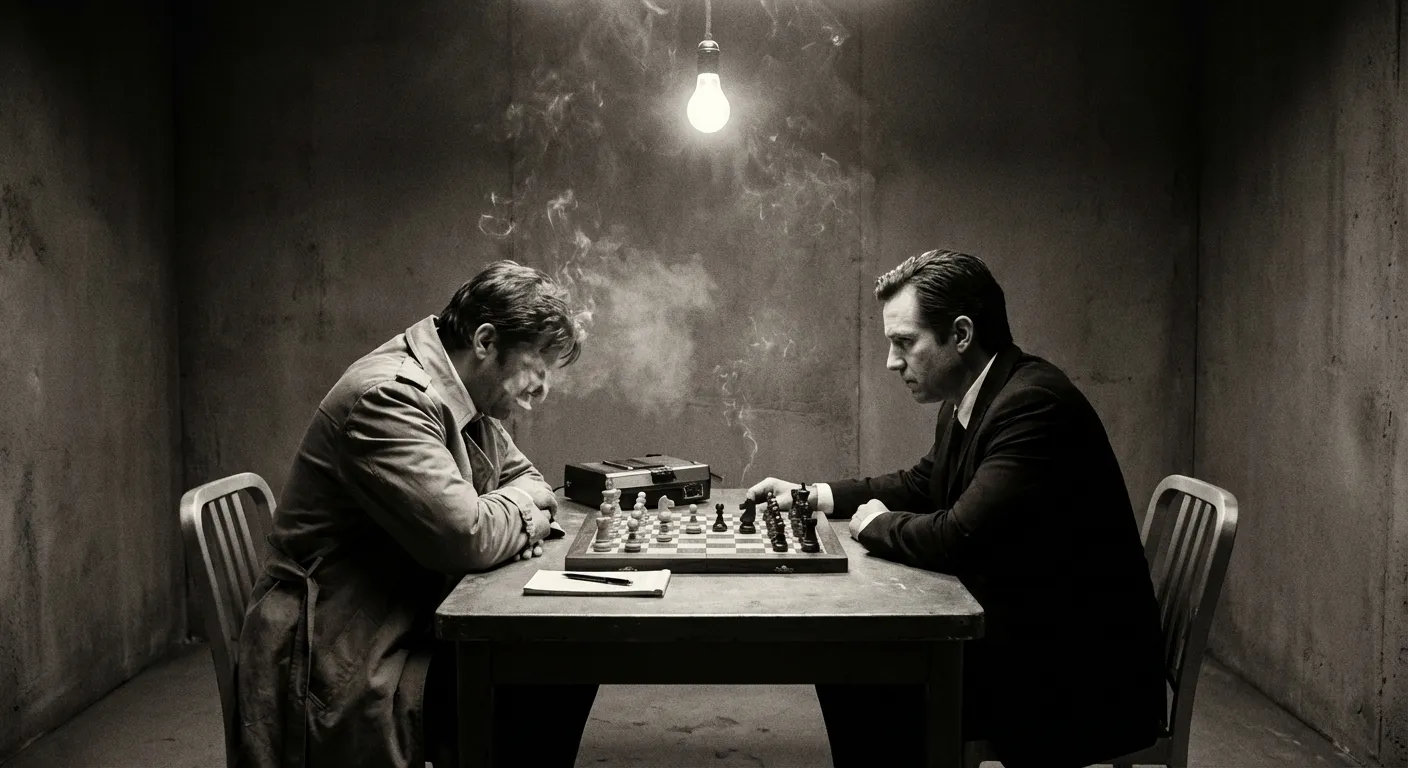
Every conversation is a chess game. Most people don't know they're playing.
I. THE PROBLEM WITH SELF-HELP
There's a reason most self-help doesn't work.
It's not because the advice is wrong. "Be confident." "Have discipline." "Read the room." This is all true. It's also completely useless — like telling a drowning person to swim.
The gap isn't information. The gap is operating system.
Chase Hughes spent twenty years in the US military, then built a career training the people who manipulate reality for a living: Secret Service agents, Navy SEAL leaders, CIA operatives, Army Psychological Operations. He wrote the Behavior Ops Manual — roughly 30,000 hours of research compressed into one document containing every technique for interrogation, persuasion, and influence that actually works.
When he looks at why people fail — in business, in relationships, in life — he doesn't see a knowledge problem. He sees something more fundamental.
He sees people running the wrong software.
II. THE THREE FACTORS
Every person Chase has evaluated — from intelligence officers to CEOs to people who can't hold a conversation at a party — can be assessed on three factors:
Self-Mastery. How well do you manage yourself? Your confidence, your body language, your internal state. This is the foundation everything else rests on.
Observation. Can you actually see what's happening? Not what you think is happening. Not what you hope is happening. What is actually happening in the room, in the person across from you, in the dynamics playing out beneath the surface.
Communication. Can you move people? Not manipulate — move. Can you speak in a way that creates change?
Most people think they need better communication skills. Scripts, frameworks, opening lines, closing techniques. Chase calls this the ACSS trap.
III. THE ACSS TRAP
A — Authority. C — Comfort. S — Social Skills. S — Skills.
Here's what happens: 90% of people who want to improve think they need more skills. Better scripts. Better checklists. Better tactics. They consume books, courses, YouTube videos, podcasts. They accumulate technique after technique.
And they still fail.
Because what they actually need is Authority or Comfort — the two things that can't be faked and can't be scripted.
Chase puts it bluntly:
"I could spend $10 million writing the best persuasion script ever created — if you're not comfortable in the conversation, you'll fail. It's not Harry Potter. We're not reading spells."
Giving someone a flight checklist doesn't make them a pilot.
The checklist assumes a foundation that isn't there. And without that foundation — without genuine comfort in your own skin and genuine authority in your presence — every technique is theater. People don't respond to your words. They respond to what's underneath your words.
IV. COMFORT — THE THING NOBODY TALKS ABOUT
Here's a competitive strategy that sounds almost too simple: be more comfortable than the other person.
That's it.
Not more aggressive. Not more dominant. Not louder, sharper, or more impressive. Just... more comfortable. Because comfort is what the mammalian brain reads as safety, and safety is what opens every door.
Discomfort is visible. It's in your breathing, your micro-movements, your speech patterns. And it triggers a mirror response in everyone around you. When you're uncomfortable, you make others uncomfortable. When you're comfortable, you make others comfortable. This is neuroscience, not philosophy.
The problem is that most people confuse composure with two things it isn't:
Collapse — making yourself small so others can be comfortable. People-pleasing. Discounting yourself. Agreeing when you don't agree. Laughing at jokes that aren't funny. Negotiating your own value downward because someone made a skeptical noise on the phone.
Chase tells a story about negotiating his keynote speaking fee. He started at $6,000. The client made one hesitant sound — not even an objection, just a sound — and Chase negotiated himself down until he was practically offering to pay them. That's collapse. That's the childhood survival strategy of making yourself invisible so the threat goes away.
Posturing — making yourself big so others back away. The pickup-artist energy. The chest-puffing. The domineering handshake. The person who speaks first and loudest in every room because silence feels like death.
Here's the trap: if you live in collapse, the "solution" looks like posturing. It's not. Posturing is just collapse wearing a costume.
Composure is the center point. Neither small nor big. Just there. Present. Unhurried. Taking up exactly the space you take up — no more, no less.
The Swimming Pool Exercise
Week one. One exercise. Move slower.
Imagine you're standing in a swimming pool. That's your speed limit for the next seven days. Every gesture, every turn of your head, every reach for your coffee — swimming pool speed.
Why? Because fear speeds the body up. Rapid, jerky movements are the universal mammalian signal for stress. When you move slowly, you're telling every brain in the room: I'm not afraid. There's no threat here. We're fine.
This isn't a metaphor. This is behavioral physiology. The body doesn't just express the internal state — it creates it. Move like someone who's calm, and the calm follows.
V. AUTHORITY — THE FIVE LAYERS
Authority isn't a personality trait. It's a structure. And like any structure, it can be built — or it can have cracks that undermine everything above them.
Chase breaks it into five components:
- Confidence
- Discipline
- Leadership
- Gratitude
- Enjoyment
The assessment is simple: rate yourself honestly on each one. Your lowest score is the highest-leverage thing to fix. Not the most interesting thing. Not the thing you want to work on. The lowest one.
Usually, it's confidence. And confidence is usually broken in a very specific way that most people don't understand.
Why Off-Camera Life Matters
Here's the part that nobody wants to hear.
How you live when nobody is watching bleeds through. Not metaphorically. Literally. It shows up in your breathing patterns, your eye movements, your posture, your speech cadence. You cannot fake it away.
Chase identifies five areas that bleed out unconsciously:
- Environment — Is your physical space organized? Clean? Controlled?
- Time — Do you manage your time, or does time manage you?
- Appearance — Not fashion. Just: do you take care of yourself?
- Social life — Quality relationships? Or isolation and resentment?
- Financial life — Are money problems creating a constant background hum of anxiety?
"If I've got an 8-foot pile of laundry, a nasty bed, dishes piled up — there's a part of our brain dedicated to reminding us: I'm faking it right now. That comes across. We manufacture gut feelings in other people."
This is why "fake it till you make it" has an expiration date. You can override the signals temporarily, but the unconscious broadcast never stops. People pick up on it. They don't know what they're picking up on — they just "have a feeling" about you.
The solution isn't to perform authority. It's to build the life that produces authority as a natural byproduct.
The Milgram Lesson
Yale University, 1962. Stanley Milgram's famous obedience experiment. Volunteers were told to administer electric shocks to a "learner" (actually an actor) every time they got a quiz answer wrong. The shocks escalated. The learner screamed. Banged the wall. Begged them to stop. Claimed he had a heart condition.
A man in a lab coat simply said: "Please continue. It's important that you continue."
Psychiatrists predicted less than 1% would deliver the maximum shock. The actual result: 67% went all the way to lethal voltage. 100% went to 250 volts — more than enough to kill.
The standard lesson is about obedience to authority. Chase adds something most people miss: novelty.
The volunteers were in a new building, on a new campus, with a new person, using a new machine, doing a new task. Everything was novel. And novelty generates maximum mammalian focus — the brain's attention systems are fully engaged, pattern-matching is disabled, and critical thinking takes a back seat.
This is why scams work best in unfamiliar environments. It's why high-pressure sales happen in special showrooms, not your living room. It's why cults move people to compounds.
And it's why, if you want authority, controlling the environment matters as much as controlling yourself.
VI. CONFIDENCE — THE VOICE IN THE CAR
Both confident and non-confident people hear the same voice.
Why am I here? I'm faking it. People will find out. I don't deserve this. Who do I think I am?
The voice is identical. What's different is the interpretation.
Chase's analogy: You're riding in a car, listening to an audiobook. A realistic BBC news alert comes on — nuclear bomb detonating in a major city. Chase, who knows it's fiction, stays relaxed. His passenger, who thinks it might be real, is terrified.
Same broadcast. Different interpretation. One person hears the self-doubt voice and thinks: Ah, that old thing. The other hears it and thinks: This is the truth about me.
Where the Voice Comes From
Nine times out of ten, the self-doubt voice formed at age eight or nine. The question that unlocks everything:
"What did that kid do to make friends or keep them? To feel safe? To earn rewards?"
Whatever survival strategy that child developed is still running. Right now. In your adult life. Without your awareness or consent.
- The kid who learned to be mean to keep people away → the adult who can't form close relationships
- The kid who kissed up to narcissistic parents → the office people-pleaser
- The kid who performed for attention → the adult who can't sit in silence
- The kid who became invisible → the adult who discounts their own value in every negotiation
These aren't personality traits. They're childhood survival apps that are still running in the background, consuming resources, shaping every interaction.
Making the Belief Absurd
Chase has clients create a desktop wallpaper with their core limiting belief stated plainly:
"I don't deserve money. Money is for other people."
Put it in a motivational poster format. Fancy font. Maybe a sunset background. Look at it every day.
The brain sees how stupid it looks. The belief loses its grip — not through argument, but through absurdity. You can't take it seriously when it's staring at you in Impact font next to a stock photo of an eagle.
The Core
Confidence, at its root, is a generalized expectation of positive outcomes. Not specific — not "I'll definitely get this job" or "She'll definitely say yes." Just a baseline sense of: things are going to be fine.
If you can install that one thing, you fundamentally change a life.
VII. DISCIPLINE — THE RELATIONSHIP WITH YOUR FUTURE SELF
Chase's definition: Discipline is your ability to prioritize the needs of your future self ahead of your present self.
Not willpower. Not grinding. Not white-knuckling through discomfort. A relationship. With a person who doesn't exist yet.
The problem: the mammalian brain doesn't speak English. You can't reason with it. You can't motivate it with affirmations. No pep talk penetrates the limbic system.
So how do you reach it?
"How would I show my goals to a dog?"
Seriously. Get it down to a mammal level. Images. Sensations. Visceral, pre-verbal experience.
The Aging App Trick
Download an app that ages your face to 95. Print the photo. Put it everywhere — your bathroom mirror, your desk, your phone background.
This creates a mammalian relationship with future-you. Not a concept. Not a goal. A face. A person you're either helping or hurting with every decision you make right now.
Once that relationship exists, discipline stops being a battle. It becomes care. You don't need willpower to take care of someone you love.
The Dopamine Map
Draw a map of everywhere you get dopamine from. All of it. Be honest.
If more than 50% comes from alcohol, porn, junk food, social media, and doomscrolling — you have a structural problem that no productivity hack will fix.
Every successful person Chase has studied has a good dopamine map. Their reward circuits are wired to things that compound: learning, creating, connecting, building. Their sources of pleasure are aligned with their sources of progress.
Be a Butler for Future-You
Practical tricks that sound silly and work anyway:
- Prep coffee maker and clothes the night before — wake up to gifts from past-you
- Stick $100 bills in jacket pockets you won't use until winter
- Write Post-It notes and hide them in dress shoes you won't wear for months
- Lay out next day's checklist, travel items by the door
The pattern: make past-you a reliable source of pleasant surprises. When you consistently look backwards with gratitude instead of regret, concern naturally flows forward to the future. The relationship becomes self-sustaining.
The Discipline Equation
Chase and Steven Bartlett co-developed this:
Discipline = WHY + Psychological Reinforcement − Perceived Cost
Every element is about perception, not reality. The cost of going to the gym isn't actually that high. But if it feels high — if the perceived cost exceeds the perceived benefit — you won't go. No amount of knowing you should will change that.
The intervention point isn't "just do it." It's changing the perception.
VIII. THE BRAINWASHING FORMULA
Chase calls it F.E.A.R. — not because it's about fear, but because of what the letters stand for:
F — Focus. Direct sustained attention to your goals. Vision boards work not because of "manifestation" but because they show the mammalian brain images. A dog can understand images. A dog cannot understand a five-year plan.
E — Emotion. The WHY must stay emotional — not just at the beginning, but continuously. This is where most goal-setting fails. The emotion fades, and without it, the mammalian brain loses interest. Use aging apps, body-simulation apps, anything that keeps the feeling alive.
A — Agitation. This is the genius move. Disrupt your environment so your brain can't default to old scripts.
Your brain writes behavioral scripts for familiar environments. Same hallway → same habits. Same couch → same Netflix binge. Same kitchen → same midnight snack. The environment triggers the behavior automatically.
So change the environment. Repaint your house. Rearrange the furniture. New wardrobe. New haircut. New route to work.
"They're not even looking at the same person in the mirror anymore."
This isn't life coaching fluff. This is the same principle used in intelligence interrogations. Change the environment, break the script, create space for new behavior to emerge.
R — Repetition. Relentless re-exposure to the same stimuli. Chase describes a client with a 70-inch TV who duct-taped a cheap tablet to the back, running a 900-slide vision board PowerPoint 24/7 — even when the TV was off, even when he wasn't in the room. Because having to turn it on each day would be an additional discipline barrier. Remove every barrier. Keep the signal running always.
IX. READING THE ROOM — THE SILENT LANGUAGE
Now the observation layer. This is where Chase's military intelligence background becomes most visible.
Blink Rate
The single most reliable behavioral signal available to anyone, in any conversation, with zero training:
- Fast blinking = high stress
- Slow blinking = deep focus
- Near-zero blink rate = predatory focus (concerning in certain contexts)
Blink rate is unconscious. It's poorly controlled manually. Unlike posture, facial expression, and tone of voice — all of which can be deliberately managed — blink rate operates below the level of conscious control. This makes it one of the most reliable signals in behavioral analysis.
You don't need to count. Just notice: is this person's blink rate normal, fast, or slow? And more importantly: did it just change?
Practical applications:
- On stage: If the audience's blink rate increases, you're losing them. Change topic immediately.
- Pitch meetings: The investor with the lowest blink rate is the most interested.
- Negotiations: A sudden increase in blink rate after you name a price = you've hit a nerve.
The Five C's
The framework for reading any behavior:
- Change — Always look for a change from baseline. A single behavior in isolation means almost nothing. Someone crossing their arms doesn't mean they're defensive. But someone who was not crossing their arms and then starts — that's data.
- Context — What's the situational explanation? Arms crossed might mean cold. Nose-touching might mean allergies. The behavior only becomes meaningful when context doesn't explain it away.
- Clusters — Look for multiple behaviors occurring together. One signal = noise. Three signals pointing the same direction = information. Nervousness + relevant question topic + protective body position + lip-licking = a cluster worth paying attention to.
- Culture — Account for cultural differences before interpreting. What looks like disagreement in one culture might be enthusiastic agreement in another.
- Checklist — Known deception and stress indicators exist, but they're the least important C. They only matter after the other four are satisfied. Always deal in likelihood, never certainty.
"Body language is delicate. You can't just point at a gesture and declare what it means."
X. THE UNCOMFORTABLE IMPLICATION
Here's what Chase Hughes actually discovered, stated plainly:
Human behavior is not random. It's not mysterious. It's an operating system — and like any operating system, it can be read, understood, and upgraded.
The confidence you feel (or don't) was installed by an eight-year-old's survival strategy. The authority you project (or fail to project) is a function of how you live when nobody's watching. The comfort you bring to a room (or drain from it) is a physiological signal that can be measured in the speed of your movements.
None of this is destiny. All of it can be changed. But not with more information. Not with better scripts. Not with another book or course or productivity system.
It changes when you change the operating system. When you stop treating symptoms and start rebuilding the foundation.
The eight-year-old who wrote your behavioral scripts had good reasons. They were surviving. But you're not eight anymore. And the scripts that kept you safe then are keeping you small now.
XI. THE INVITATION
There's a reason Chase put everything into his Behavior Ops Manual. He received a brain diagnosis. He realized he might lose the ability to think clearly. So he wrote it all down — 30,000 hours of research into human behavior — while he still could.
The urgency wasn't theoretical. It was biological. And it produced something honest.
What Chase offers isn't a hack. It's not a trick. It's a way of seeing human interaction for what it actually is: a complex but comprehensible system that can be understood, navigated, and mastered.
The question isn't whether you have the information to change. You do. You've always had it. The question is whether you'll change the operating system — the one that was installed decades ago, by a version of you that no longer exists, for problems you no longer have.
Move slower. Build the life that produces authority naturally. Stop competing on skills and start competing on comfort. Draw your dopamine map. Be a butler for future-you.
And pay attention to blink rate. You'd be surprised what people tell you when they think they're not speaking.
Based on Chase Hughes' appearance on The Diary of a CEO with Steven Bartlett.
Chase Hughes is a former 20-year US military veteran, behavioral analysis expert, and creator of the Behavior Ops Manual. He runs the Behavior Panel YouTube channel and is the author of Phrase Seven.
The difference between knowing and understanding is the difference between reading a flight checklist and being a pilot.
Which one are you?